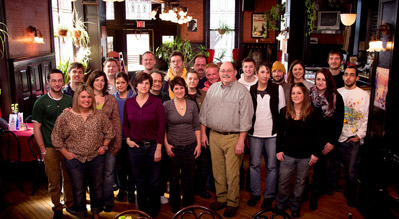
The Lancaster Dispensing Company has been proudly serving fine food and spirits since its opening in 1978. Located in the heart of historic downtown Lancaster, Pennsylvania, our Victorian establishment is situated on the site of the Grape Tavern of 1893. The impressive red building you see today started as the headquarters for an early 20th century social organization. Extensive renovations resulted in the current 19th Century look of the Lancaster Dispensing Company, returning the site to its original use.


Lancaster's Central Farmer's Market
Located right next door to DipCo!

Lancaster's Market is one of the oldest continuously operating public farmer's markets in the nation. For 270 years, the people of Lancaster have come to the central market square area to buy foods from local growers and producers. People began meeting here to sell and shop in the 1730s. The current building used for the market, called the Central Markethouse, was built in 1889. "Market", as it's called by the locals, offers a wide variety of local delicacies. From locally grown produce to meats, cheeses, baked goods, fish and even flowers
and crafts; you'll be sure to find something you like at Market.

Lancaster Quilt and Textile Museum
Located right next door to DipCo!

Explore the rich and diverse textile traditions of Lancaster County and south-central Pennsylvania through this rich and diverse collection that celebrates the role of textiles in the past, present, and future. The Quilt & Textile Museum's permanent collection showcases quilts produced by Amish women in Lancaster County between the 1870s and the 1940s. Visitors will learn about the history of the Amish, defining characteristics of Lancaster County Amish quilts, the process of making a quilt, and more. The stunning array of colors and patterns in these artifacts provides a window through which to view the people who created them.

The Fulton Opera House
Located on Prince Street, one block west of DipCo.


A significant player in America's theatrical heritage, the Fulton Opera House was built in 1852 and is one of only three theatres nationwide designated a National Historic Landmark. The Fulton Opera House is a Member of the League of Historic American Theatres. Renovated in 1995, the Fulton boasts an extraordinary marriage of 19th-century grace and 20th-century comfort. A gem of Victorian architecture, the theatre's lush interior includes a magnificent main lobby with sweeping staircase and crystal chandelier, custom-designed seats with plenty of leg room, and a classic seating plan that makes every seat in the house a good one!

The Heritage Center Museum of Lancaster County
Located at Penn Square, one block south of DipCo.

Housed in the historic 1798 City Hall and Masonic Lodge Hall, this museum offers exhibits of quilts, clocks, silver and fine arts from the Lancaster County area. The museum offers both permanent and changing displays.
The Heritage Center Museum invites you to get to know some of the area's most fascinating characters. For free. The Museum collects, preserves and interprets Lancaster County's history and decorative arts through the permanent collection, annual exhibitions and educational programming. You'll find out why Amish dolls have no faces, why there's an ever-watchful eye peering down from the ceiling and why the face in the
tall-case clock changes from sun to moon.


The Demuth Tobacco Shop
Located on King Street, 3 blocks southeast of DipCo.

Christopher Demuth, son of a Moravian
immigrant from Karlsdorf, established
the Demuth Tobacco Shop in 1770. Today,
the Demuth Tobacco Shop is still operating
on King Street, making it the oldest tobacco shop in continuous operation in the country.
After being run by 5 generations of Demuths,
the store is now run by the Demuth Foundation.
The foundation also operates and maintains
the home/studio of Charles Demuth. Charles
Demuth (1883-1935) was one of America's
foremost artists of the 20th century and
cousin of Christopher. The inspiration for
much of his artwork was the garden at the
Demuth family home, built in the late 1700s.